GEOCitation Research
79% of SEO Agencies Ranked #1 on Google Are Invisible to Gemini
GeoCitation.io just ran the largest cross-market study comparing Gemini citations to Google SERP rankings in the SEO industry. 500 audits. 194 local markets. 3 countries. The finding: in 4 out of 5 markets, Gemini recommends a different agency than the one ranking #1 on Google.
- Audits
- 500
- Local markets
- 194
- Countries
- 3
- Gemini citations
- 26,700+
The data behind this study
This isn't a survey. It's raw output from GeoCitation.io's Market Intelligence API, which queried Gemini under real conditions across 194 local markets, SEO agencies and SEO consultants, in the US, the UK, and France.
| Market | Cities | Sub-queries | Gemini citations | Unique domains cited (per-city, summed) |
|---|---|---|---|---|
| SEO Agencies (United States) | 56 | 1,120 | 7,568 | 4,141 |
| SEO Agencies (United Kingdom) | 28 | 560 | 3,659 | 2,180 |
| SEO Agencies (France) | 68 | 1,360 | 9,556 | 4,563 |
| SEO Consultants (France) | 42 | 840 | 5,928 | 3,208 |
| Total | 194 | 3,880 | ~26,711 | 14,092 |
Data volume per market: cities, sub-queries, citations, and unique cited domains analyzed by this study.
Note: the domain count above sums unique domains per city, so a domain cited in multiple cities is counted more than once. Deduplicated at the full market level, the real unique-domain totals are 201 (US), 97 (UK), 240 (France agencies), and 239 (France consultants).
Bottom line: 3,880 generative sub-queries and over 26,700 Gemini citations went into the findings below.
Context and methodology
Google isn't the only gatekeeper anymore.
Generative engines, Gemini foremost, the model powering the entire Google ecosystem (AI Overviews, AI Mode, Search), now recommend vendors directly, no link list required.
So who gets picked? And on what basis?
GeoCitation.io ran 500 audits through its Market Intelligence API over the first two weeks of August 2026. Each audit fires 20 sub-queries at Gemini per local market, then tracks which domains actually get cited.
Methodology note: this study is Gemini-only. ChatGPT and Perplexity reason differently and select sources differently, mixing them would blur the signal. Every finding below describes Gemini's citation behavior specifically, not an average across engines.
Each leader page also went through a natural language processing (NLP) pass: semantic completeness, recognized-entity density, actual length of the cited passages. The goal wasn't just “who gets cited”, it was “why.”
Every number below comes straight from these audits. Nothing is estimated.
Key findings
1. The great divide: Google ranks, Gemini picks differently
| Market | Cities | Google/Gemini alignment |
|---|---|---|
| SEO Agencies (United States) | 56 | 12.5% |
| SEO Agencies (United Kingdom) | 28 | 14.3% |
| SEO Agencies (France) | 68 | 25.0% |
| SEO Consultants (France) | 42 | 31.0% |
| Global (194 markets) | 194 | 21.1% |
Google/Gemini leader alignment rate by market: how often the top-ranked Google domain is also the most-cited Gemini domain.
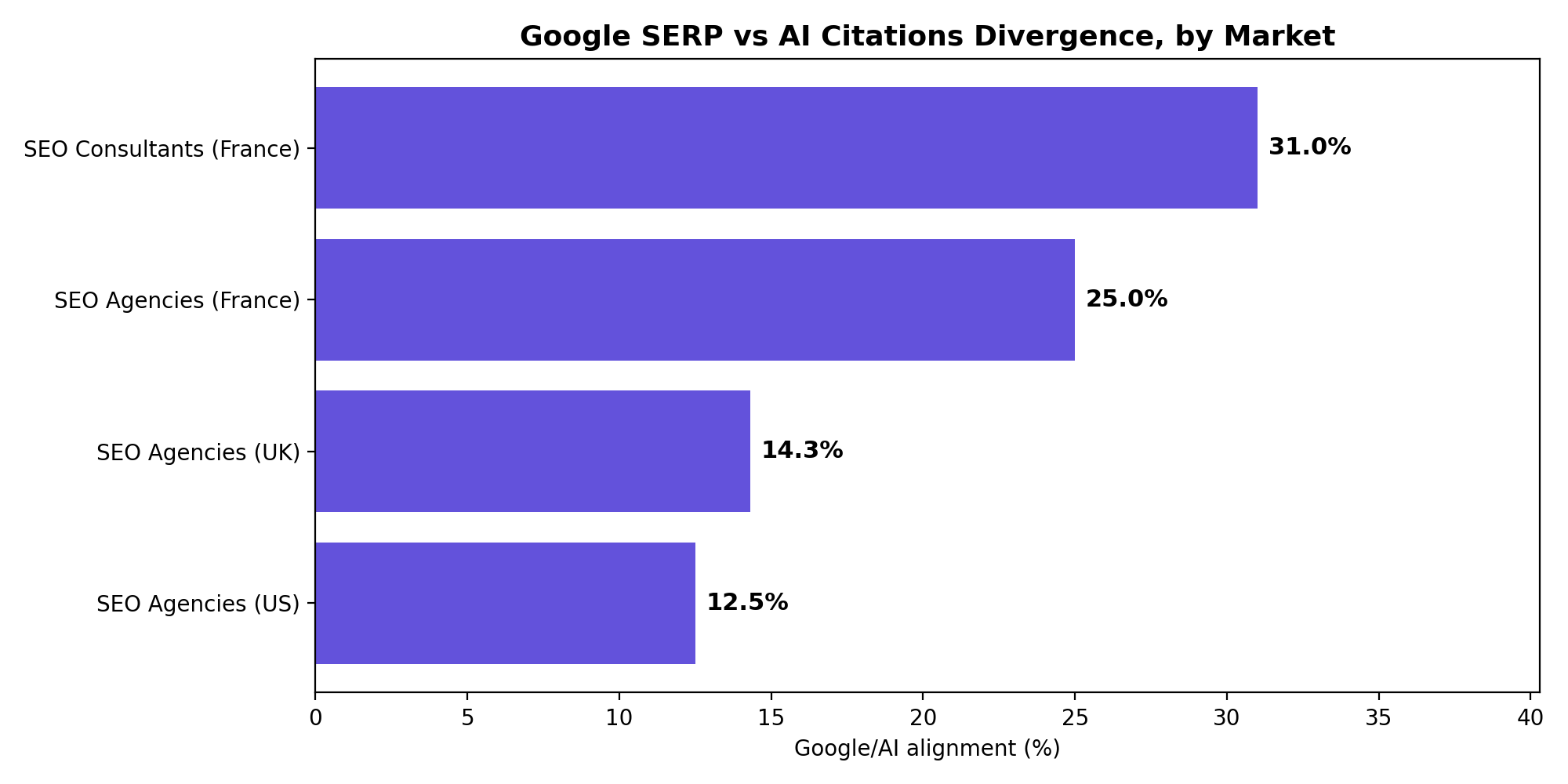
“In the US, Google's rank-1 agency and Gemini's most-cited agency are the same company in barely 1 out of 8 markets.”
This isn't a US anomaly. The same gap shows up 5,000 miles away, in France, Europe's largest SEO market, in a different language entirely, at comparable rates. At a 21.1% average alignment across all 194 markets, that's 78.9% of markets where Google and Gemini disagree, roughly 4 out of 5.
2. What actually separates a Gemini leader from the rest
Beyond rank, GeoCitation measured the linguistic and factual makeup of every leader page using three standard NLP metrics:
- Semantic completeness: how much of the topic is actually covered with verifiable facts (0 to 1 scale)
- Entity coverage: the presence of recognized entities, people, places, organizations, in the text
- Knowledge Graph entity density (per 1,000 words): how many entities in the text are anchored to a verifiable knowledge base (think Google's Knowledge Graph), not just loose mentions
| Market | Leader's avg. semantic completeness | % of leaders ≥ 0.9 | “High” entity coverage | Market entity density (per 1,000 words) |
|---|---|---|---|---|
| SEO Agencies (US) | 0.973 | 85% | 100% of cases | 45.3 |
| SEO Agencies (UK) | 0.975 | 91% | 100% of cases | 38.3 |
| SEO Agencies (France) | 0.937 | 71% | 100% of cases | 48.5 |
Leader page NLP profile by market: average semantic completeness, share of leaders scoring 0.9+, entity coverage, and market entity density per 1,000 words.
“In this sector, a Gemini leader page carries close to 50 verifiable entities per 1,000 words. That density is what 'citable' actually means here.”
A negative result matters just as much: a page's “semantic proximity” to its own topic, a classic relevance measure, is not correlatedwith getting cited first. The Gemini leader is almost never the most “on-topic” page in its own market: it sits in the middle of the pack on this metric. Relevance isn't the driver. Verifiable fact density is.
“Being the most relevant doesn't get you cited. Being the most verifiable does.”
A second dead end: image count. The intuition says a more visual page gets cited more. The numbers don't back it up, the gap between leaders and the rest of the corpus swings from +49% to -7% depending on the market, too unstable to be a real factor, unlike entity density.
What matters isn't how many images a page has, it's whether they're real. Confirmed leaders (Sortlist, Clutch) require actual team and agency photos per vendor listed, not stock images or AI-generated visuals. A photo, like a paragraph, proves nothing if it can't be verified.
“Adding photos isn't enough. They have to be the real ones.”
3. The winners: aggregators, never a single agency
Gemini favors pages that compare multiple vendors over pages that talk about themselves.
- Clutch.co leads 23 of 56 US markets (41%) and 8 of 28 UK markets (29%)
- Thriveagency.com, a multi-location agency (not a directory), leads 10 US markets and 3 UK markets, proving a single company can win without being an aggregator
- Tool-advisor.fr leads 6 of 68 French markets
“In the US, one single domain (Clutch.co) is the top-cited source in 41% of every market studied.”
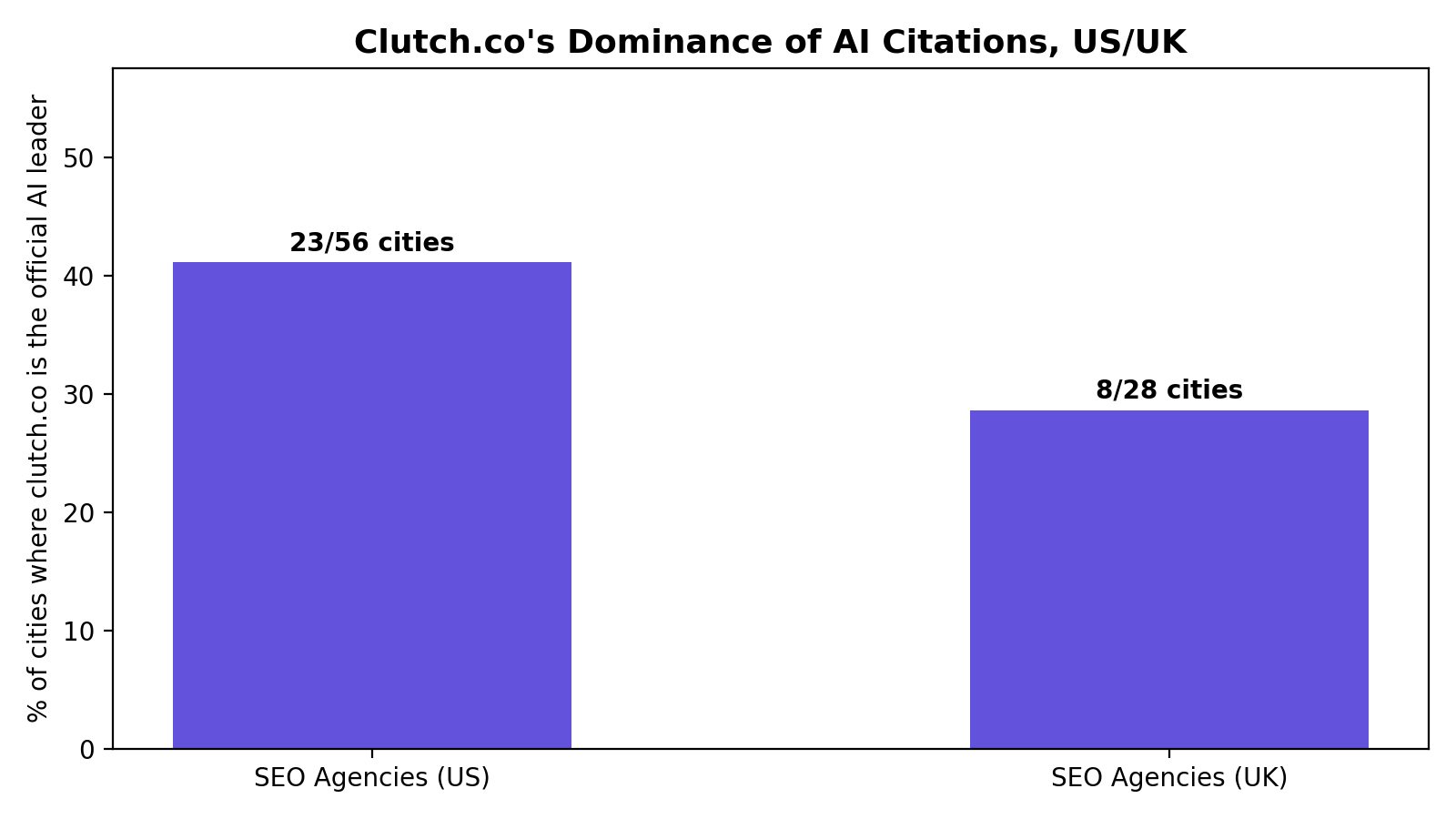
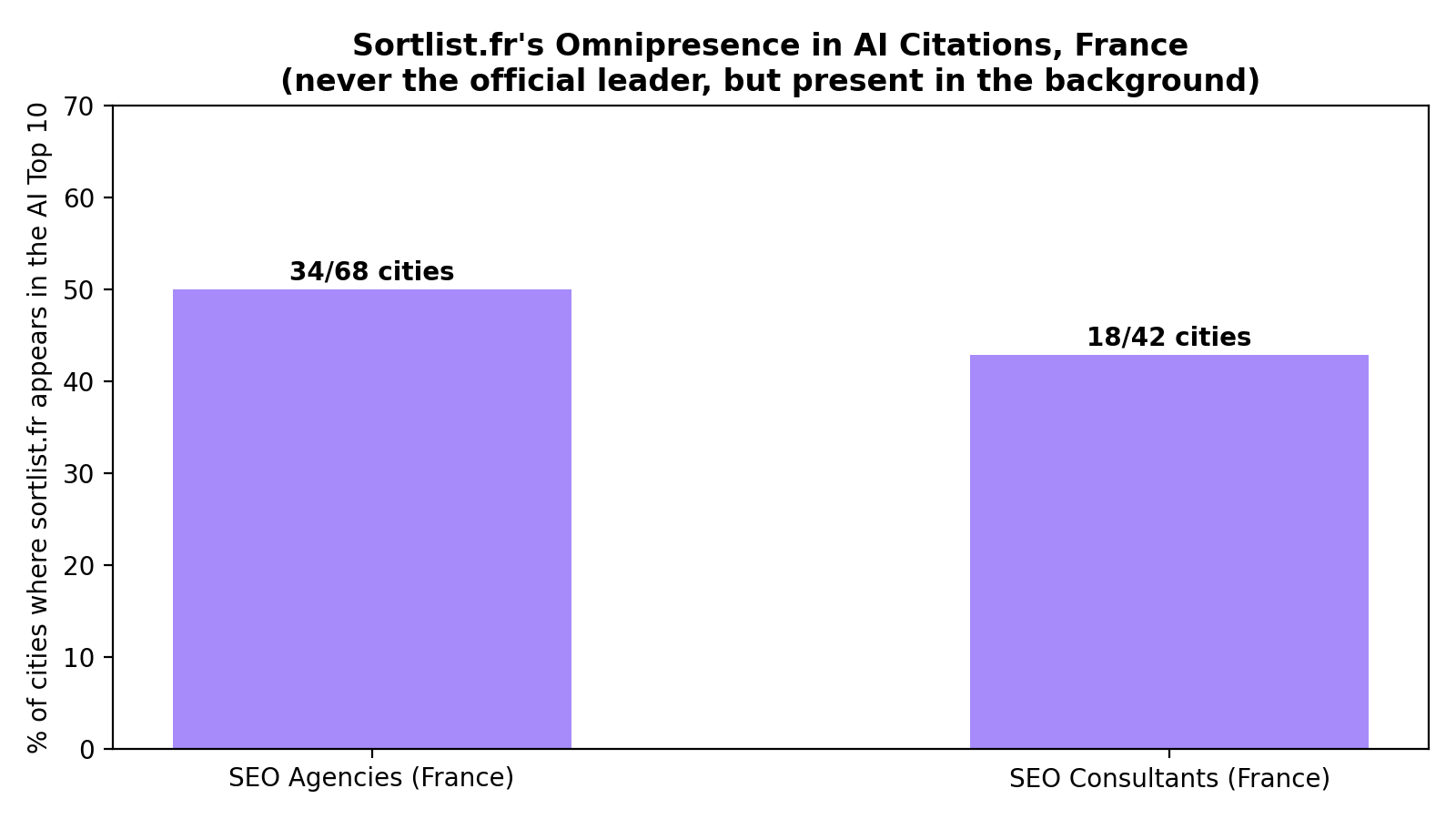
Two strategies win: the directory that compares multiple vendors, or the agency that documents its own proof, market by market.
A third, quieter strategy shows up in France: omnipresence without ever winning outright. Sortlist.fris never the official leader in any of the 68 French agency markets, yet it appears in Gemini's Top 10 citations in 50% of agency markets and 43% of consultant markets. Never first, almost always present: a position just as strategic as outright dominance.
The gap between formats shows up hardest in raw citation volume. Helium-seo.com, Google's #1 ranked agency in Indianapolis and a genuinely known brand, pulls just 43 citations across the entire US market. Clutch.co pulls 358 on that same market, an 8x gap. In France, the pattern repeats: eskimoz.fr, one of the country's best-known SEO agencies and Google's leader in Paris, totals 41 citations nationwide, against 285 for sortlist.fr, 7x fewer. Of the 12 most-cited domains across the entire US market, 9 are directories or comparison sites. The first standalone agency doesn't show up until rank 13.
“The best-known agency brand in America pulls 8 times fewer citations than the directory that lists its competitors.”
One nuance complicates the picture: not every winning strategy looks the same. Sortlist.fr shows up in 74% of French cities, averaging 5.7 citations per city: wide reach, moderate intensity. Tool-advisor.fr does the opposite: present in only 16% of cities, but averaging 10.1 citations where it does appear: rare, but overwhelming. Being everywhere and being dominant are two different paths to citation.
Domination stays split, though: across all 194 markets, the top 10 most-cited domains capture 43.5%of total citation volume. No single domain tops 41% in any one country. There's still room.
4. Corporate websites dominate almost everything
| Cited source type | US | UK | FR agencies | FR consultants |
|---|---|---|---|---|
| Corporate (business websites) | 98.5% | 98.7% | 99.5% | 99.2% |
| Editorial, Institutional, Social, UGC, Video | 1.5% | 1.3% | 0.5% | 0.8% |
Share of Gemini citations by source type, by market: corporate business sites vs. editorial, institutional, social, UGC, and video sources.
“99% of Gemini's citations come from corporate websites. Media, blogs, and forums barely register.”
5. What Gemini's leaders have in common
Eight signals show up consistently on the most-cited pages, regardless of country:
- A comparison naming multiple real vendors
- A verifiable address or geographic zone
- A price range
- Team size
- Dated third-party certifications (Google Partner, Clutch, UpCity...)
- Named clients
- Numeric reviews, ideally across multiple platforms
- High density of verifiable entities per word
Counterintuitive fact: not one leader observed relies on a detailed methodology or a long case study. Verifiable fact density beats editorial depth, every time.
“The pages Gemini cites aren't the most expert ones. They're the most verifiable ones.”
6. The winning sentence: 34 words
Across 9,882 passages pulled from leader pages, the average length of the actually-cited passage is 34 words. 99.6% of these passages get flagged as “too short” by conventional copywriting standards, and they're the ones getting cited anyway.
Real examples pulled straight from leader pages:
- “Rated 5/5 with 104 verified reviews” (onfolio.com, Seattle)
- “Thrive's Chicago SEO specialists” (thriveagency.com)
- “Moov'Up is a Lyon-based SEO agency with 15 years of experience” (translated from French)
A proper noun. A hard number. A short sentence. Same pattern, in English and in French.
7. Three independent methods land on the same signal
Three separate analyses, run independently on the same dataset, converge on one conclusion: a rare level of agreement in applied research.
Semantic clustering.An unsupervised clustering algorithm (one with zero concept of “directory,” grouping pages purely by vocabulary proximity) consistently places the Gemini leader in the same cluster as known comparison sites. In the 10 French cities tested, that held true 10 out of 10 times. Across US/UK markets where Clutch.co is the confirmed leader, 8 out of 10 markets show another competing directory (onfolio.com, seo.co, designrush.com...) in the exact same cluster. In Anchorage, Alaska, six directories cluster together on a single market.
Dominant vocabulary.A purely lexical analysis, unrelated to citation data or page format, shows that the vocabulary dominating a market isn't technical. Across 40 French cities analyzed, the most frequent terms are real agency names and trust-building language(“highly recommended,” “top agencies,” “award-winning”). Pure SEO jargon (“optimization,” “algorithms,” “backlinks”) stays in the minority.
“The page that dominates a market doesn't speak better SEO. It names more real entities and reassures harder.”
Three methods, three angles (citation, clustering, vocabulary), one conclusion.
Discussion and recommendations
These findings overturn a common assumption in SEO: that editorial authority and content depth are enough to secure future visibility.
Generative engines seem to reward something else entirely: the density of verifiable factual proof, benchmarked against multiple real competitors in the same market.
Four concrete moves follow:
- Document, don't just describe. Replace self-promotional paragraphs with verifiable numbers: address, pricing, team size, certifications, reviews.
- Name your local competition. A page comparing 3 to 5 real local vendors has a statistically better shot at citation than a single-vendor page.
- Write short and dense. Target passages of 25 to 40 words combining a proper noun with a hard number, instead of long paragraphs.
- Replicate by city, not by argument. For a multi-location business, duplicating a standardized proof block (address, reviews, certifications, client results) across every city page beats writing different editorial content each time.
About and contact
GeoCitation.ioisn't a marketing or SEO agency: it's a semantic data engineering company providing API access to proprietary intelligence. Its product quantifies “citability”: the probability that a piece of content gets selected and cited as a source by a generative AI (Gemini, ChatGPT, Perplexity). Two audit types are available: Market Intelligence, which maps an entire competitive market, and Gap Analysis, which benchmarks a single page against its market leaders. Both run through a deterministic 9-phase pipeline. The team is built from data architects, data scientists, Knowledge Graph specialists, and systems engineers.
This study was conducted by Karim Haddaoui, Founder and Chief Systems Architect at GeoCitation.io. Before GEO, he spent a decade building organic acquisition architecture for international B2B brands (a Toptal network member, top 3% globally, from 2012 to 2022) after training as an industrial engineer (Mohammadia School of Engineers, with stints at Valeo and Centrale Danone). He now applies that same systems-engineering rigor to generative search. His thesis, in one line: “SEO is the foundation. GEO is the citation. Miss one, lose both.”
Press contact: support@geocitation.io
LinkedIn: linkedin.com/in/karimhaddaoui
Full methodology and raw data available on request. Explore the city-by-city ranking on the GeoCitation index for US SEO agencies or UK SEO agencies.